Item #3:
Applying Learning Design
Practical Solutions for Today’s Methods

E
In Item #3, we introduce the more popular instructional methods used in the field today.
These methodologies are the models and frameworks instructional designers use as guidelines when creating a program or solution. They share many similarities but each has a unique approach to the design process.
A development strategy to quickly create a prototype of the instructional materials and testing them with learners to identify areas for improvement.
Organizing learning objectives based on cognitive demand required to achieve each – Remember, Understand, Apply, Analyze, Evaluate, Create
For interview purposes, it’s important to at least be familiar with the main concepts of these models.
You’ll find each project comes with its own challenges, and the best methodology you use will depend on the specific needs of the participants and design of instructional materials.
Instructional Design Models
Courtesy of our friends at IDOL Courses
In her video, Dr. Sargent covers several common design approaches you’ll likely hear about when interviewing for design positions.
While it’s important to be aware of these frameworks, in the Become an Instructional Designer program we’ll focus primarily on the models we recommend when creating concept projects for instructional design portfolios.
Let’s get started!
Action Mapping
One of our favorite design approaches, Action Mapping – created by Cathy Moore – takes a rational approach to learning solutions.
Action mapping is a streamlined process to design training for the business world. Its goal is to help designers:
- Commit to measurably improving the performance of the business
- Identify the best solution to the performance problem
- When training is necessary, create realistic practice activities, not information presentations
Here is a visualization of the Action Mapping components used in depicting a solution around a specific action.
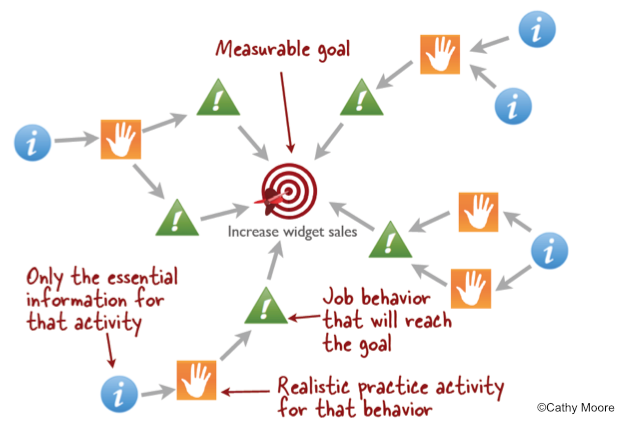
“A focus on real-world behaviors rather than assessment questions.” – Cathy Moore
Why Action Mapping?
- The process is intuitive and the benefits are easy to see
- People grasp the concept right away
- Enables designers to include rich, engaging scenarios
- Stakeholder and SME management is a lighter lift
The High-Level Questions (the model asks):
- What’s the problem? How will we know we’ve solved it?
- What do people need to DO, and why aren’t they doing it?
- How can we help them PRACTICE what they need to do?
- What information MUST they have to complete the practice activity?
Curtesy of Cathy Moore’s site
The Kirkpatrick Model
We are covering this model because of its focus on the outcomes of a learning solution or program and how those outcomes are measured – which is super important when making a case for an organization to invest in a training and development program.
Typically, it’s a challenge to measure the results of a program, especially outside of a corporate setting. The Kirkpatrick Model is one way to achieve this with success.
You may be looking for a design position within an organization that currently has a training and development department. Referencing the Kirkpatrick Model can set you apart from other candidates by showing how you can, and will, measure results.
So what is the Kirkpatrick Model?
A tried and true model used by professionals through decades of research and application and has found success in all sectors; government, military, corporate, consulting, etc., on topics such as onboarding, product and program launches, leadership development, diversity, equity, and inclusion (DEI), safety, security, and succession planning.
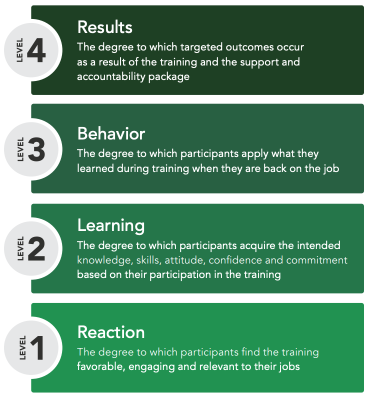
The Kirkpatrick Model has four levels:
Level 1: Reaction
How favorable, engaging, and relevant participants find the training experience
Level 2: Learning
How much participants acquire knowledge, skills, attitude, confidence, and commitment based on the training experience
Level 3: Behavior
How participants apply what they learned when they are back on the job
Level 4: Results
The outcomes or effects the student’s performance has on the business.
Courtesy of Kirkpatrick Partners, LLC
Item #3 Takeaway
There are many effective methods, models, and frameworks for designing training solutions, and we could detail the advantages of each. The key takeaway here is HR and hiring managers are looking to see if you grasp the main concepts of the more widely used approaches.
With a solid project or case study in your portfolio, you’ll not only show you understand these concepts but can apply them to real-world problems with measurable outcomes.
We’ll present examples later in the program – especially when you meet with a GimmeCredit Expert.
You have completed Item #3!
Contact us to personalize the rest of your learning path
Please note: clicking the above button will open an email in your preferred email client.
Other Resources
We can geek out over design methods all day, but if you’d like to take a deeper dive into some of the approaches mentioned above, here are a few selected articles and videos:
ADDIE Model: Instructional Design – an article on Educational Technology’s blog, by Dr. Serhat Kurt
Successive Approximation Model (SAM) – an article on Kennesaw State University’s website, no author
Model Of Motivation: ARCS Instructional Design – an article on Education Library’s blog, by Dr. Serhat Kurt
3 Basic Steps of Backward Design Lesson Plans – an article on the University of San Diego’s Professional and Continuing Education website, no author